Every app on your Mac.
At its own volume.
Turn a call down, keep the music up, and send each app to the speakers or headphones you choose. It lives in your menu bar, it is free, and there is no audio driver to install.
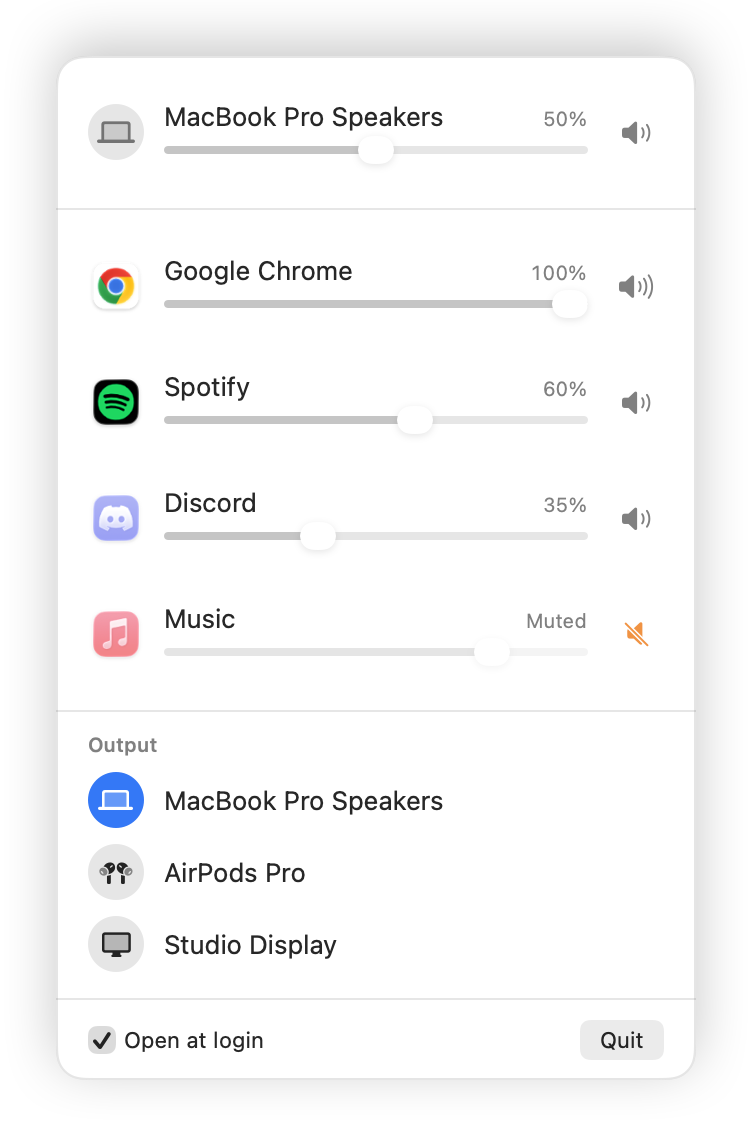
Works with anything that plays sound.
From too loud to just right, in one click.
- 01
Drag one app down.
Turn the browser down so it stops talking over your music. Nothing else moves.
- 02
Mute the one that won't stop.
Click the speaker next to the game. It goes quiet without pausing.
- 03
Pick where it plays.
Click the output icon next to the video call and pick Headphones. The game is already there, the rest stays on the speakers.
 It remembers each app's level and output, so you set it once.
Calls in your ears.
Music in the room.
- Any app, any device. Speakers, headphones, a display or AirPlay. Each app picks its own.
- Falls back on its own. Unplug the headphones and the app moves to your default output.
- Comes back when you do. Plug them in again and the app goes straight back.
No driver. No clutter. No leftovers.
No driver to install
Built on the audio taps in macOS 14.4. Other mixers add a virtual sound card. This one is just an app.
Browsers are one row
Chrome, Safari and Electron apps play sound from helper processes. They fold into the app you know.
Helper (Renderer)Helper (GPU)→BrowserQuit, and it is gone
Every route belongs to the app. Quit it, or if it ever crashes, macOS removes them and your sound is back to normal.
And the small things that make it feel built in.
- Volume keys for the app in frontTurn it on in Settings and the volume keys change the app you are using. ⌥ + the keys still change the whole Mac.
- Mute All, from anywhereOne click in the panel, or ⌃⌥M in any app. Press it again and every app gets its own mute back.
- Output priorityPut your devices in order. The first one connected becomes the output, at the volume it had last time.
- Pin an appKeep an app in the list while it is quiet, so it is already set before it plays.
- Play one solo⌥-click an app's speaker to hear only that app. Do it again to bring the rest back.
- Scroll, or use the keysScroll over a row to change it. A focused slider moves 5% with the arrow keys, 1% with ⇧.
Your sound stays on your Mac.
macOS asks once to let the mixer hear other apps. Nothing is recorded or saved, there is no account and no analytics, and the only network call is the update check.
Smorza Pro.
Set it and forget it.
The mixer above stays free. Pro lets it adjust itself.
One email when Pro is out. Nothing else. Privacy
- ProfilesGaming, Meeting, Focus. Every level and output with one shortcut.
- Auto-duckingMusic dips when someone talks on a call, then comes back.
- Boost to 200%For quiet videos and calls, with a limiter so nothing clips.
- Global mic muteOne shortcut, every app, and an indicator you can trust.
Questions before you install.
macOS says it can't check Smorza. How do I open it?
Smorza is not notarized by Apple yet, so macOS asks once on the first launch. The code is open on GitHub if you want to see what it does. Move Smorza to Applications, then:
- macOS 15 Sequoia or later: open Smorza and click Done on the warning. Go to System Settings → Privacy & Security, scroll down and click Open Anyway.
- macOS 14 Sonoma: right-click Smorza in Applications, choose Open, then Open again.
After that it opens like any other app, and updates install themselves.
Is Smorza safe?
Yes. The whole app is open source under the MIT License, so anyone can read what it does. It installs no audio driver or system extension: it uses the audio taps Apple added in macOS 14.4. Sound is changed in memory only and is never recorded, saved or sent anywhere. The app has no analytics, no account and no tracking. If you turn on the volume keys option, macOS asks for Accessibility so Smorza can see the volume keys, and it reads nothing else. Its only network request is the update check, and every update is signed, so Smorza only installs updates that come from its developer.
Why does macOS ask to record system audio?
To change an app's volume, Smorza takes its sound before it reaches the speakers and plays it back at the level you chose. macOS calls that recording, so it asks once. Nothing is saved or sent anywhere, and apps at 100% never go through the mixer.
Can I control each browser tab?
No, and no app can do this well on macOS. Chrome, Safari and other browsers play every tab through the same helper processes, so Smorza folds those helpers into one row for the browser. You set the volume and output for the whole browser.
Does Smorza remember my settings?
Yes. Each app's volume, mute and output are saved by its bundle ID and for each output device. Quit Spotify, open it again, and it comes back at your level on your device, even after a restart. Unplug your headphones and plug them back in, and every app goes back to where you had it on them.
Is it really free?
Yes. Per-app volume, mute and output are free, and the code is MIT licensed on GitHub. Pro adds automation on top (profiles, auto-ducking, boost, mic mute) for $2.99 once, with no subscription. It is coming soon and optional.
Does it work alongside SoundSource or Background Music?
Tools that route the same apps can fight over them. Use one at a time for the apps you adjust.
Which Macs does it run on?
Any Mac on macOS 14.4 Sonoma or later, with Apple silicon or Intel.
How do I uninstall it?
Quit it from its panel and move it to the Trash. To also remove the permission, run this in Terminal:
tccutil reset AudioCapture com.rokoov.smorza